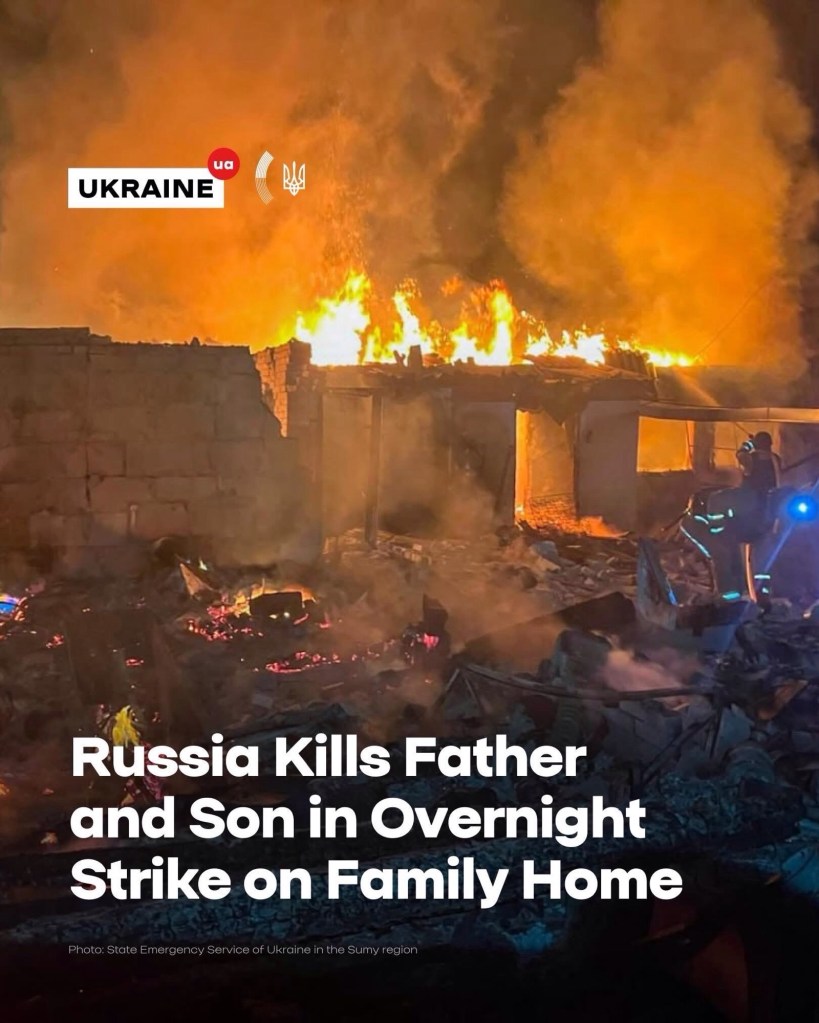
For four and a half years, Russia has been battering Ukraine’s civilian population with missiles and drones in a no-holds-barred war of attrition — killing babies, women, and old folks; destroying homes, shops, schools, hospitals and transportation hubs; kidnapping children and re-homing them in Russian territory; and burning wheat fields in order to systematically starve the Ukrainian people.
And now, when Ukraine launches a successful drone attack on Russian tankers in the Sea of Azov — ships operating in violation of existing international sanctions — Russian Foreign Minister Sergey Lavrov has given us one of his best straight-faced stand-up routines:
“What the Ukrainian regime is doing goes beyond even piracy. Pirates, at least, plunder and keep the spoils for themselves. But here, it benefits neither them nor anyone else — the goal is simply to cause damage and intimidate. It is terrorism, pure and simple.” [Reuters, July 14, 2026.]
Sergey Lavrov
Methinks someone needs to educate that man about people who live in glass houses . . .
Even in Shakespeare’s time, it seemed that bad luck, tragedies and misfortunes were often piled one on top of the other:
“When sorrows come, they come not single spies. But in battalions!”
– William Shakespeare, “Hamlet,” Act IV, Scene 5
William Shakespeare (1564 – 1616)
So if you’ve been thinking that the seemingly endless deluge of bad juju our world has been experiencing is unusual, it’s probably not true. But it sure can feel that way sometimes.
I, for one, am ready for a miracle.
Hmm . . . I wonder what the Bard had to say about miracles . . .
Between 1932 and 1933, millions of Ukrainians died of starvation in what was known as the Holodomor, or the Ukrainian famine. It was not caused by drought, floods, or crop infestation. It was manmade, most likely resulting from the disastrous effects of forced collectivization by the Soviet government.
It is still being debated whether that famine — which affected other parts of the Soviet Union as well — was intentionally created by Josef Stalin as a means of controlling the peasantry. But it quickly became obvious that, at the very least, its advent was used by him to press the people of Ukraine into submission, and to quash their nationalist sentiments and resistance to Soviet policies.
Yes, even then — nearly a century ago — Ukraine was fighting for its historic sovereignty. And the Soviet government was using the most lethal weapons at its disposal to prevent their success.
Fast forward to 2026. Josef Stalin is long dead . . . as is the political entity formerly known as the USSR, now broken apart into 15 independent nations, the largest and most powerful of which is the Russian Federation. But Russia, under Vladimir Putin, has not given up its lust for control of the country known as the “breadbasket of Europe.”
Now four and a half years into its war of attrition against the sovereign nation of Ukraine, Russia is growing desperate. The “special military operation” that was to have lasted no more than a few weeks has dragged on. Rather than frightening the Ukrainian people into submission, the invasion of 2022 only strengthened their resolve, and brought the allied nations of Europe, the United States, Canada and others to their defense.
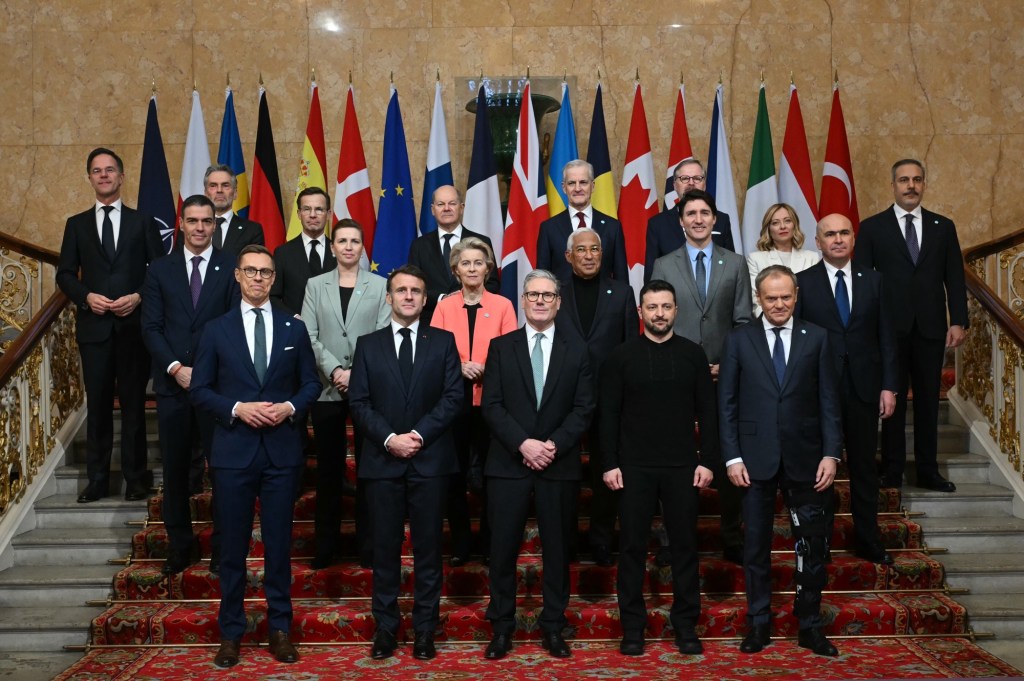
Coalition of the Willing
Even 21st-century technology hasn’t won the day for Putin’s armies; on the contrary, Ukraine has become the world’s leader in the newest military innovation: drone warfare. And in his desperation, Putin — who has been viciously and illegally targeting civilians and civilian infrastructure throughout the war — has now resorted to the cruelest, most inhumane tactic in his arsenal: starvation of the civilian population. But not by the slow method of poor crop management employed by Stalin.
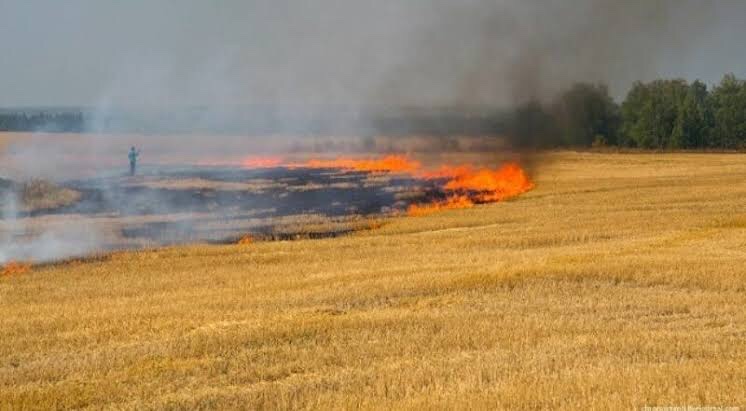
In the face of Ukraine’s unexpected push-back, Russia is once again — using modern methods of attaining maximum kill in minimum time — attacking agricultural lands with incendiary bombs, burning thousands of hectares of wheat and other crops in a matter of mere hours.
Viktor Hordiyenko,, a farmer in Ukraine’s Kherson region whose father was killed last year in a Russian drone strike, this year has lost his crops to Russian attacks:
“A hundred a day. This is not an exaggeration. A hundred drones a day. Shelling every day. They’re hunting us. They burnt 2,000 hectares of my wheat in a single night. Winter wheat, all the crops you see, have been scorched.” [Yevhenia Nazarova, RFE/RL, July 11, 2026.]
Kherson, Ukraine – July 2026
He added that the number of attacks has tripled recently — at harvest time — since just a few months ago.
Oleksandr Tolonnikov, deputy head of Kherson’s regional military administration, told RFE/RL that:
“The security situation in the Kherson region continues to deteriorate. Russia is not reducing the intensity of strikes, but, on the contrary, is systematically increasing terror against civilian residents.” [Id.]
The obvious goal: Starvation, leading to submission.
And the human and economic toll will likely stretch beyond Ukraine’s borders. It is one of Europe’s largest suppliers of wheat; a reduction in exports would affect, not only Ukraine’s economy, but those of other countries as well. The tentacles of Vladimir Putin’s immoral and blatantly illegal actions will reach far and wide.
But has he considered the possibility that his recent escalations might turn around and bite him in the ass? His war has already cost him dearly, both economically and in terms of his popularity . . . possibly even threatening his hold on power. Will this latest obscene cruelty be the final straw?
His ingrained autocratic nature will never allow him to concede. But autocrats have historically become the instruments of their own downfalls by reaching too far. They don’t have to call it quits; the people eventually do it for them.
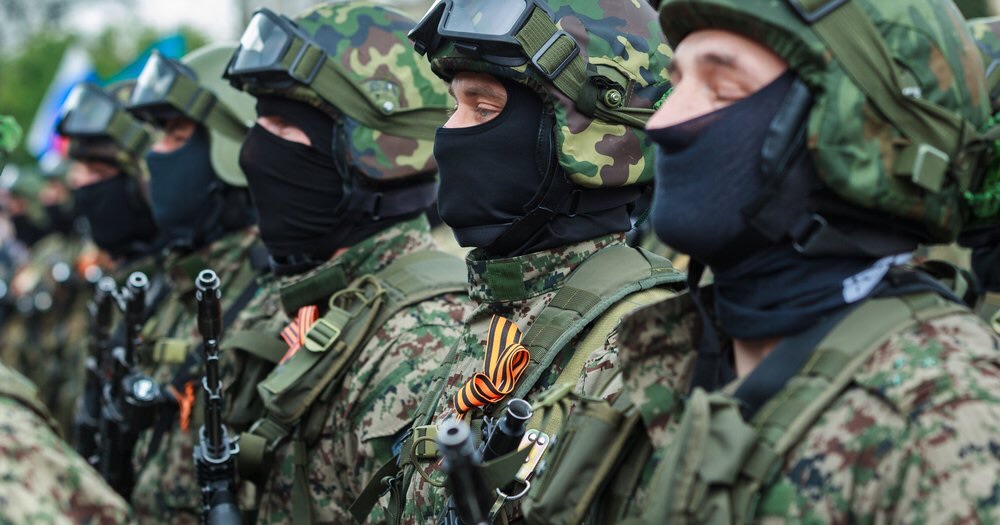
Two more innocent civilians have been murdered in cold blood by agents of the misnamed Department of Homeland Security. If you think ICE is not out of control, and that we are not headed down the path to total fascism, please take this simple test:
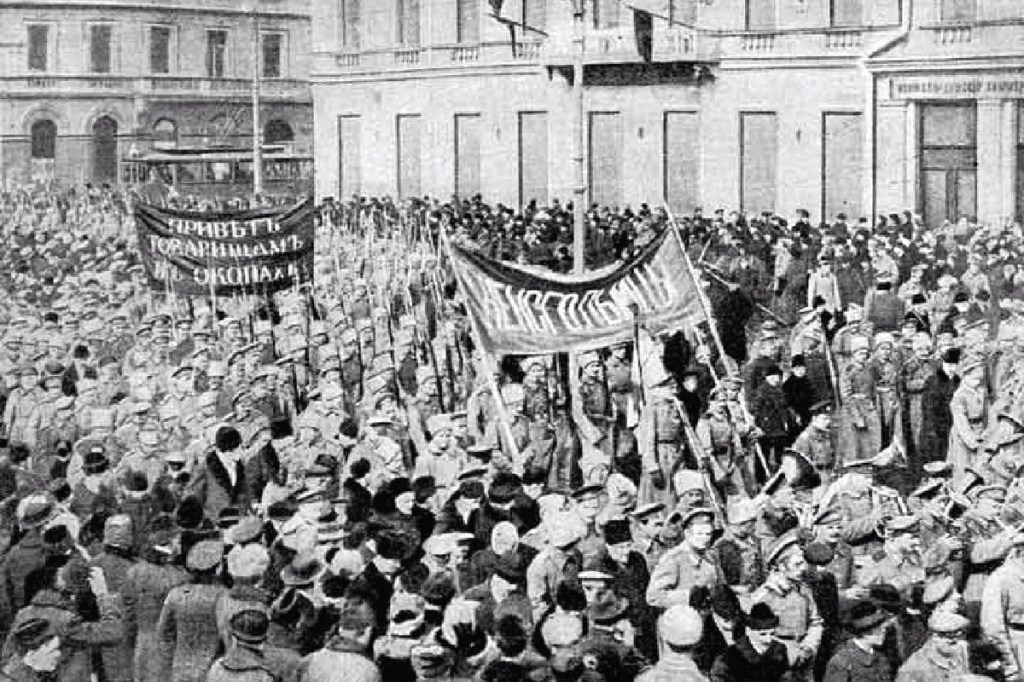
You tell me which of the two groups below are the ICE agents and which are the Russian Wagner Group of mercenaries.
Now ask yourself:
“What in the name of all that’s holy has this country come to?”
When an American government-sanctioned paramilitary group is virtually indistinguishable from a Russian band of marauding mercenaries, we are in deep shit, people.
Just sayin’ . . .
Brendochka 7/14/26
FYI, the Wagner Group are in the top photo. And if those ICE goons don’t scare the bejeezus out of you, nothing will.
We humans wonder why, after centuries of trying to create a system of government that actually works for everyone, our efforts continue to be stymied.
It turns out that the answer is really quite simple: We are trying to achieve the impossible.
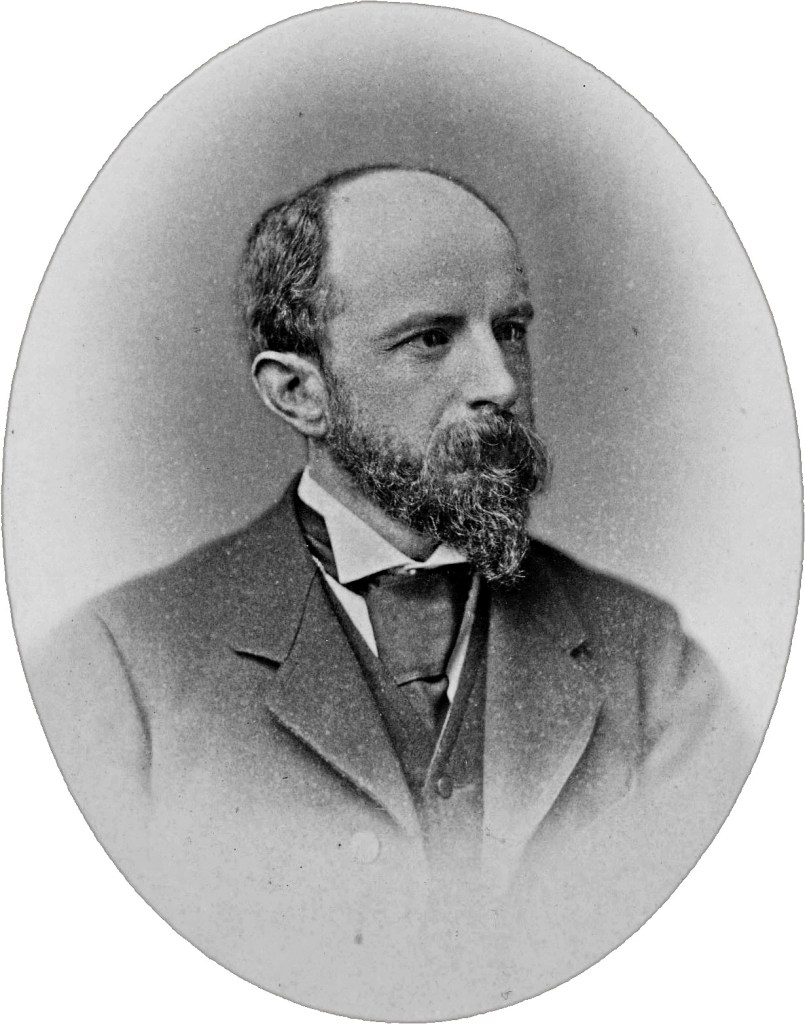
According to American historian Henry Brooks Adams, a descendant of two U.S. presidents, John Adams and John Quincy Adams:
“Chaos was the law of nature; Order was the dream of man.”
– Henry Brooks Adams, “The Education of Henry Adams”
Henry Brooks Adams (1838 – 1918)
No wonder we’re in such a mess. Instead of working with Nature — as some indigenous peoples have been trying to teach us — we’ve been attempting to outsmart her. And any idiot knows you can’t do that.
Mysterious deaths and disappearances are nothing unusual in Russia. A journalist (Anna Politkovskaya) who reported on the war in Chechnya is shot and killed in the hallway of her apartment building; an opposition leader (Boris Nemtsov) is shot and killed on his way home from dinner, just yards from Red Square and the Kremlin; a famed dissident (Alexei Navalny) is poisoned but survives, then is arrested and dies mysteriously in prison; a high-ranking military officer opposed to the war in Ukraine is killed by a car bomb; a close associate of Vladimir Putin who dared criticize the military (Yevgeny Prigozhin) is blown out of the sky when his private plane explodes; a startling number of officials and other VIPs “fall” out of windows to their deaths.
In Moscow, it’s just business as usual.
Those things don’t happen here in the United States. The current administration has somewhat less drastic — though still vicious and unethical — means of dealing with adversaries: some are fired from their jobs for specious reasons, or no reason at all; others are sued for ludicrous sums of money; still others have their reputations besmirched. The lucky ones are just called “moron,” “scum,” “loser,” or “piggy.”
But when two mysterious events take place in rapid succession, involving two senior and very powerful members of the U.S. Senate, the mind of an old Russia hand such as myself naturally turns to the most ominous, albeit unlikely, scenarios. It is easy to imagine what events such as these would have meant had they occurred in Moscow . . . and to be thankful that we still don’t do things that way.
Just think about it.
First was 84-year-old Mitch McConnell, seven-term Senator from Kentucky and a fierce ally of Donald Trump. He has had numerous health problems over the years, so it wasn’t surprising to learn that he was once again hospitalized on June 14th. The public was advised that he had been injured in a fall. But when the details of his condition are kept secret, he is not seen or heard from for a month, and a still photo is finally released that can only be described as a hybrid of scenes from “Dave” and “Weekend At Bernie’s” . . . well, one has to wonder why.
McConnell’s survival is of extreme importance to Trump and the entire Republican Party because of the order of succession in Kentucky. His party cannot risk his Senate seat going to anyone other than a Trump loyalist in a special election.
So is McConnell being kept technically alive, perhaps on life support, for the requisite amount of time? Or is he . . . ?
Well, that doesn’t even bear contemplating.
*. *. *
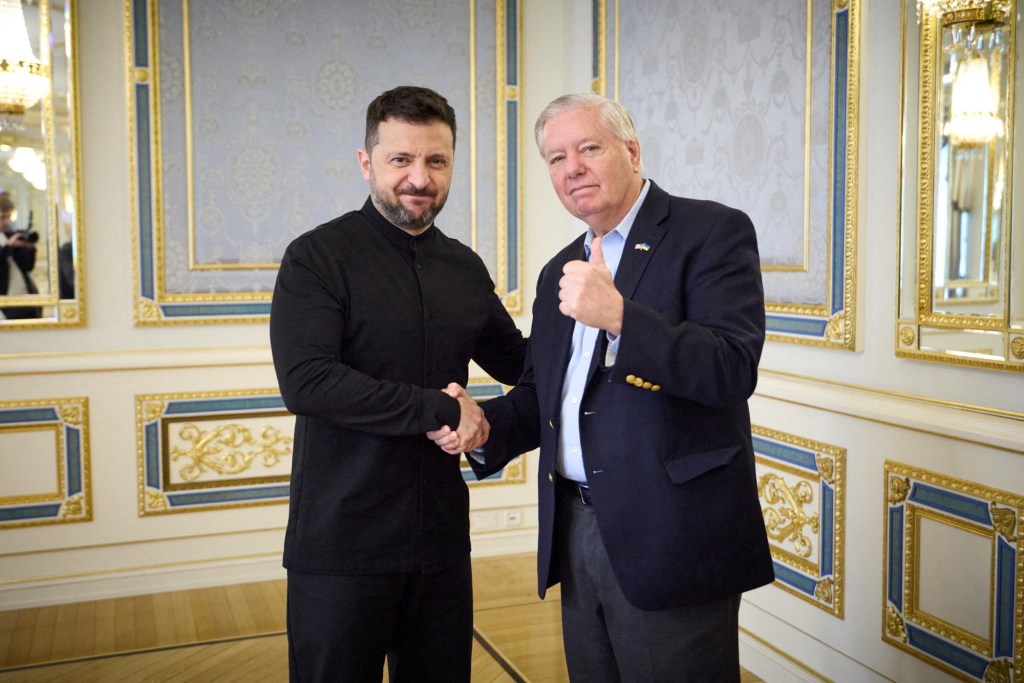
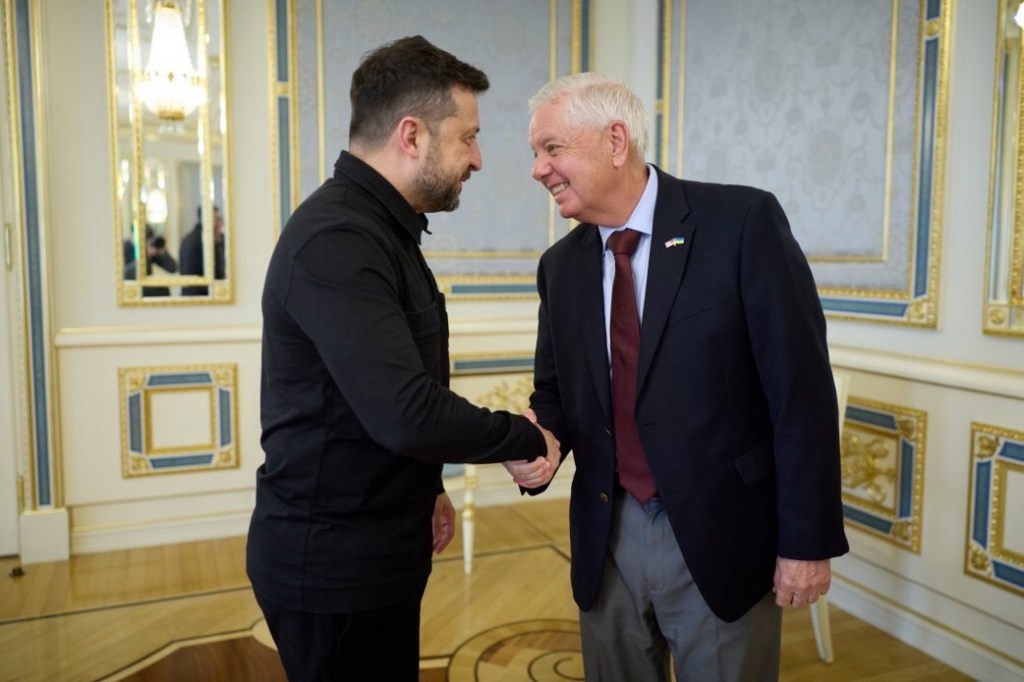
Even more shocking, because it was totally unexpected, was the sudden death this weekend of another Trump loyalist, 71-year old Senator Lindsey Graham of South Carolina. His death came just a day after a very successful meeting in Kyiv with Ukrainian President Volodymyr Zelensky, in which he assured Zelensky of America’s continuing support . . . despite Trump’s recent cooling attitude toward the provision of additional help for the war-torn ally.
In Kyiv – July 10, 2026
Reports are that Graham suffered a sudden cardiovascular event resulting from an apparently unsuspected, silently progressive condition. And there is no reason at this time to question that diagnosis.
But if we were in Moscow, and Graham were a member of Putin’s inner circle of siloviki (strongmen, or people of influence), our first reactions might have been entirely different.
All of which makes me very grateful that, despite the distressing devolution of the Trump administration into blatant authoritarianism, we haven’t yet sunk quite that low.
I have long believed that no one can match, much less surpass, the wisdom of the ancient Greek philosophers . . . except, perhaps, the ancient Chinese philosophers.
Possibly the best known of these was Lao Tzu (alternatively spelled Laozi), revered as the author of the Tao Te Ching, one of the foundational texts of Taoism.
Being on something of a journey myself at the present time, I decided to see what he had to say about the directions we take in life, and I was immediately reminded of these famous words:
Lao Tzu
Well, having already taken that first step, I dug a little further into Lao Tzu’s writings and was delighted to find this bit of irony:
“If you do not change direction, you may end up where you are heading.”
Looking in Another Direction
How delightful it is to know that even the ancients could be possessed of both wisdom and a sense of humor.
And what excellent advice for some of today’s world leaders and their slavish followers . . . if only they had the intelligence and the will to listen.
It’s well known that Ukraine’s recent successes in targeting and destroying so many Russian oil refineries and tankers has played havoc with fuel supplies on the Russian mainland, and in Russian-occupied Crimea.
Lining up for gas in Crimea
As to Crimea in particular, fuel is being severely rationed (if available at all), and there have been reports of a large-scale exodus of those who purchased property there, or simply came to visit, on Vladimir Putin’s assurances that life was good in the Black Sea paradise since his illegal invasion and occupation in 2014 . And apparently, it has been . . .
. . . that is, until he decided to stage a repeat performance involving the whole of Ukraine in 2022. And the rest is well-known: a war, in its fifth year, that is not going at all as Putin had anticipated and promised. Since then, Crimea itself has become a war zone, particularly in areas housing military facilities and in coastal areas where Russia’s famous Black Sea Fleet has been located, making them prime targets of Ukraine’s drone forces.
Striking Russia’s “Shadow Fleet”
Why, then, were the Feenstras — Arend, Anneesa, and seven of their eight children — sent to that very place on a week-long farm tour?
Their specific location on the peninsula has not been mentioned in their videos, and it appears that their first two days were spent at inland agricultural areas — much safer locations, due to the absence of military installations that might be targeted by Ukraine. So I followed them through three episodes on their long train ride and to a couple of apparently thriving farms, where they learned a good bit about Russian agriculture and husbandry.
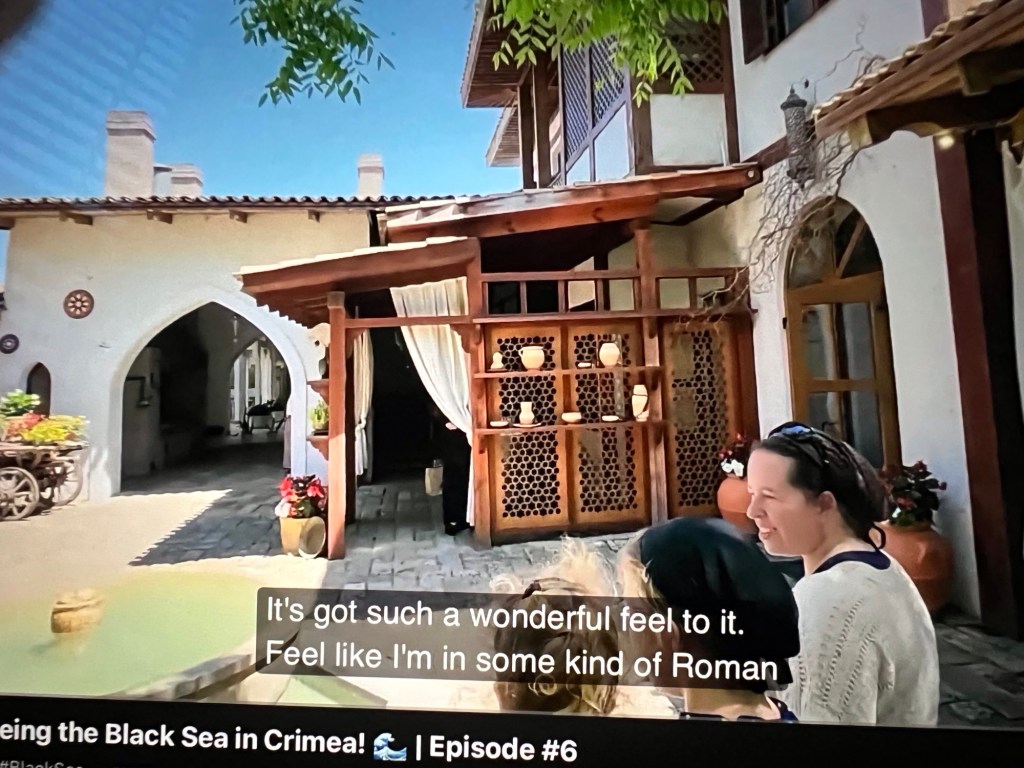
Skipping over episodes 4 and 5 — visits to a goat farm and a cheese farm — due to a lack of time and, quite frankly, a waning interest in the details of Crimean farm life, I went directly to episode 6: a relaxing day by the Black Sea.
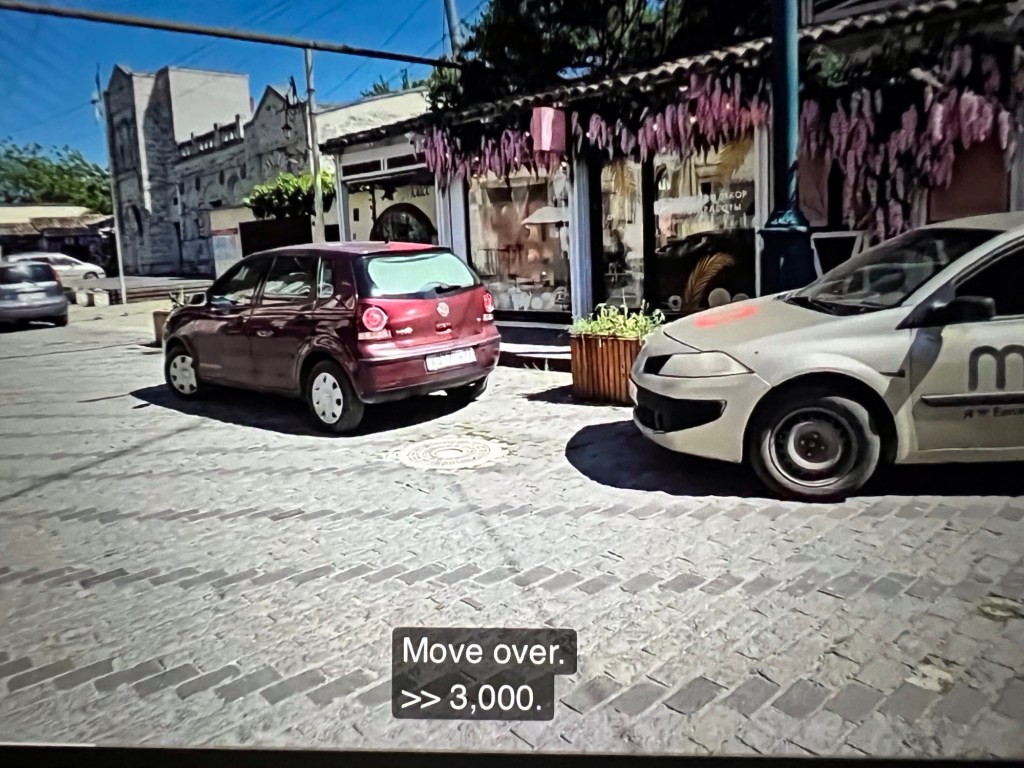
In the older part of town
My reason for this was twofold: first, to see how the videos would depict life in the more populated areas of Crimea; and also to make a comparison, as much as possible, with the Black Sea resort (Sochi) I visited on my first trip to the then Soviet Union in 1988.
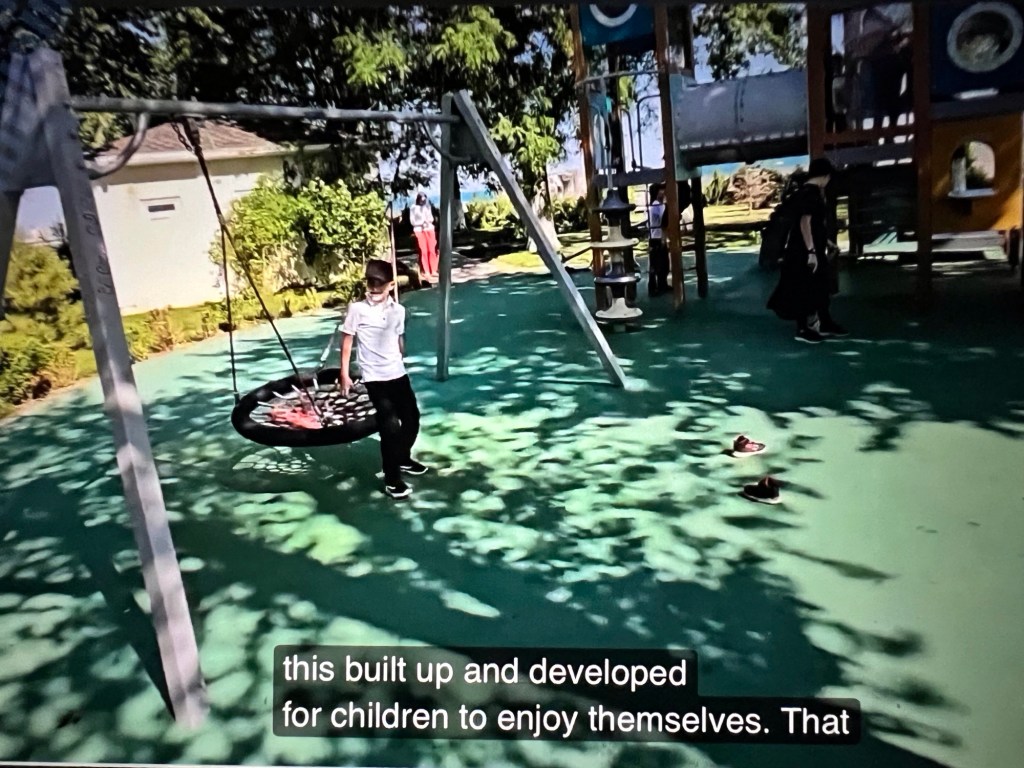
Obviously, 38 years can make a tremendous difference. And, as Arend Feenstra explained in the video, the recreational areas have been updated and expanded in just the last eight years. Needless to say, he commented on how clean and “gorgeous” everything is, how much attention is paid to lifestyles that help “build community” throughout Russia, and how important that is to quality of life in general. If he hadn’t become a farmer, he would have been a great public relations guru.
A Park and a Playground
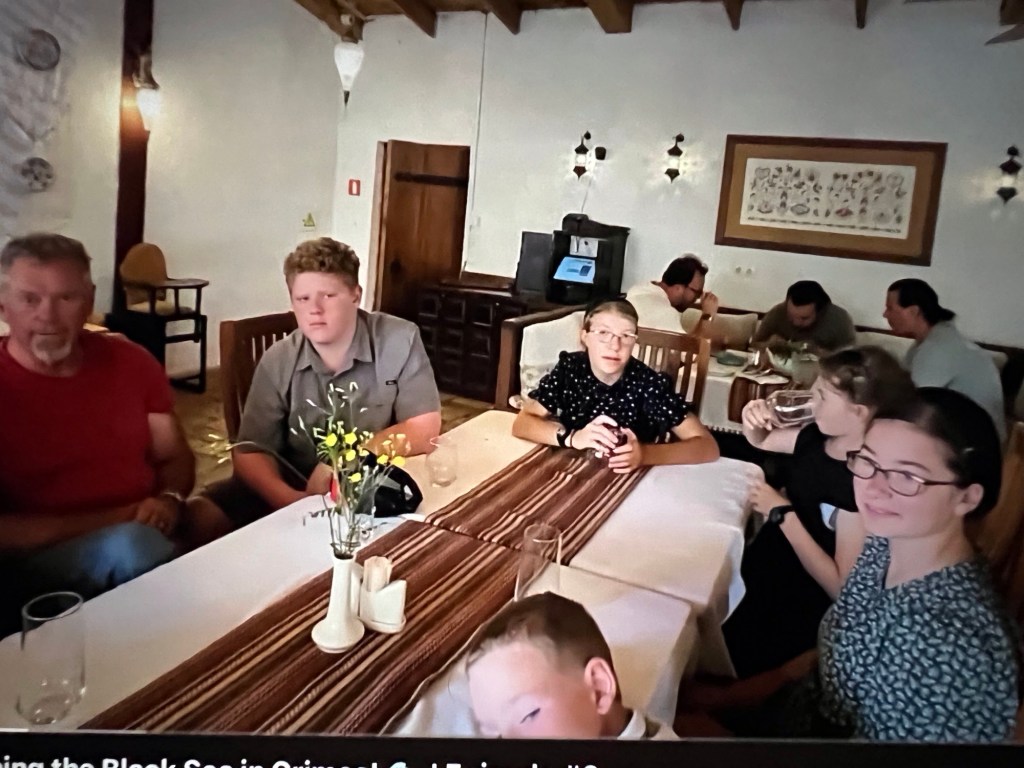
There was a stop for lunch.
And more strolling around town.
Before Gas Rationing?
Again, the exact location was not revealed, but it appeared to be a small resort city or town, with both historic and newly-developed areas. He began his video by commenting on the historically amicable co-existence of substantial Muslim and Jewish communities in the region, and pointed out an “Orthodox church” — without mentioning whether it was Russian or Ukrainian Orthodox. The smart money would be on Russian, of course, as all Ukrainian history, language, culture and religion have been or are being eradicated by Putin in Russian-occupied areas.
An Orthodox Church
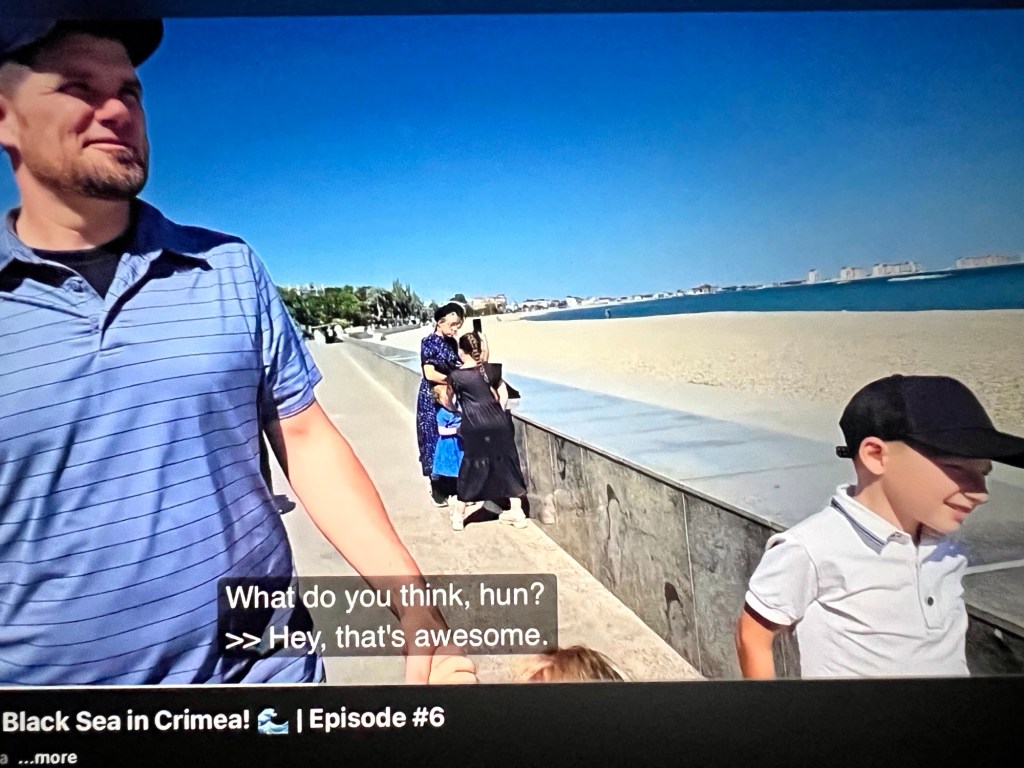
The video ended with a walk to the Black Sea itself, where one thing hadn’t changed: the typically European rocky beach surface. (We Americans are accustomed to soft sandy beaches.) Some of the Feenstras seemed to have no difficulty walking barefoot on the stones. But I distinctly recall the amusement of some locals when I was unable to manage without my rubber flip-flops, even in the water.
First look at the Black Sea from the Crimean side
Little Maddie kept her shoes on to navigate the rocks.
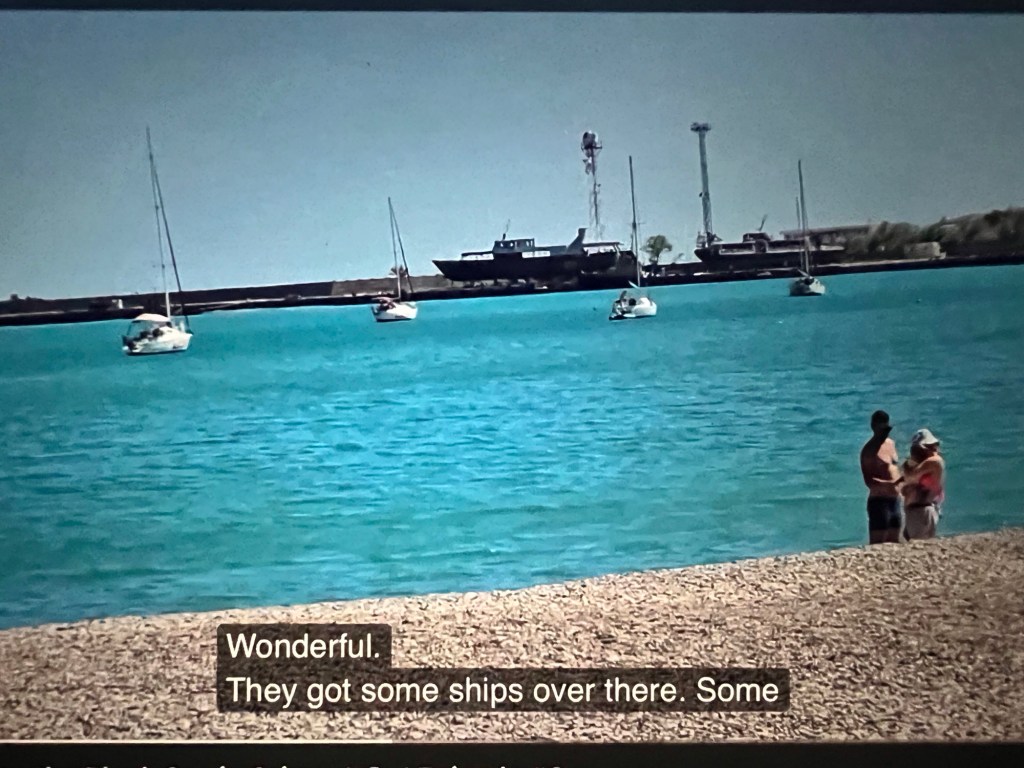
Happily, the region they visited was indeed beautiful and peaceful. The video showed a coastline devoid of large military vessels — just a couple of lesser ships in the distance, a few smaller boats, and a plethora of lovely swans.
View from the coastline
A bevy of swans . . . and I believe I spy a gosling
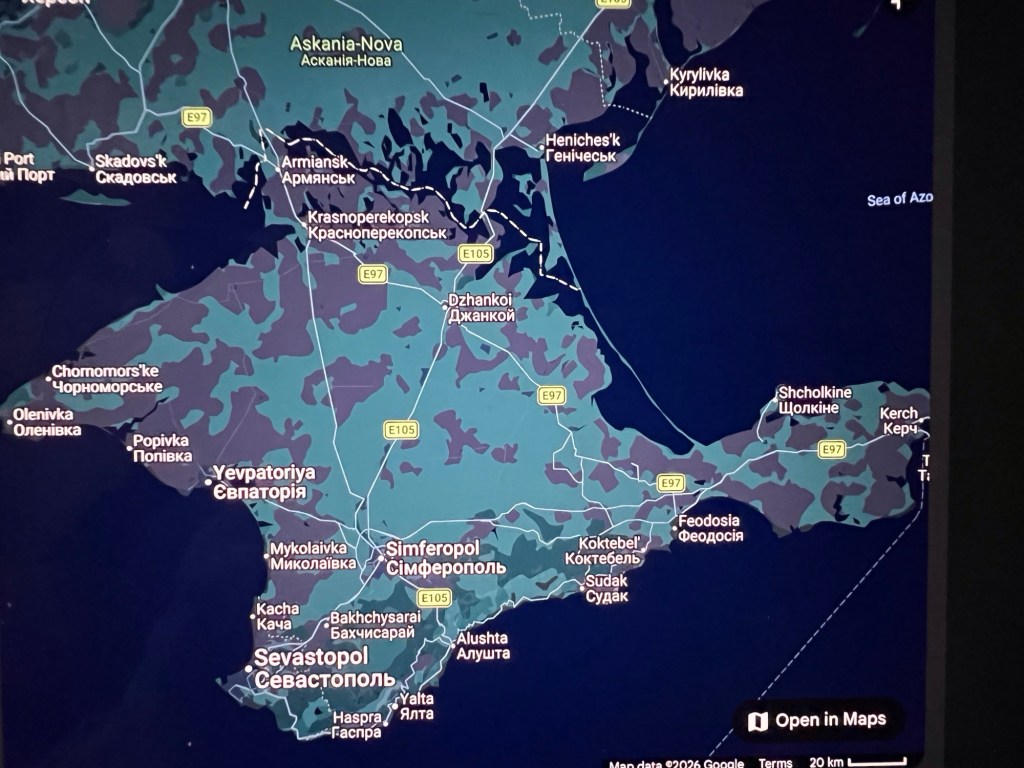
Looking at a map of Crimea, they could have been anywhere along a lengthy stretch of coastline.
The Black Sea is at the lower right corner
And it was obvious from the videos thus far that their itinerary was well planned to keep Russia’s celebrated Canadian emigres as safe as possible.
No, this is not a eulogy for Lindsey Graham . . . but it is about him, indirectly.
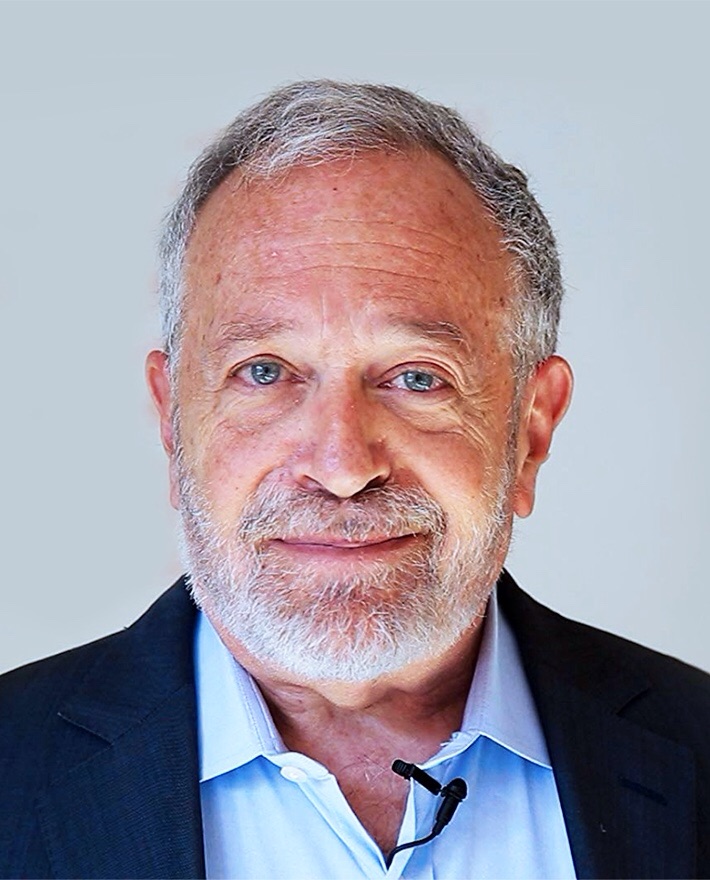
It is, rather, about this man:
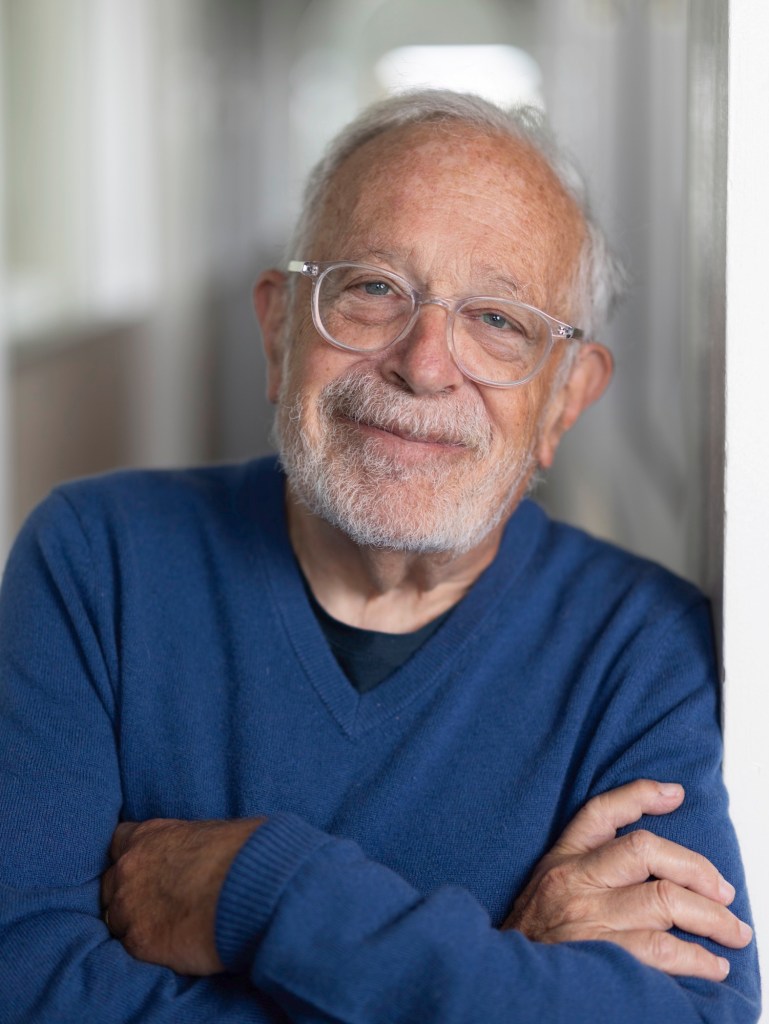
Robert Reich, former U.S. Secretary of Labor
Graham passed away last night, just two days after returning from his meeting with Ukrainian President Volodymyr Zelensky in Kyiv. Predictably, the news and social media reports are filled with some praise, much criticism, and a deluge of downright meanness about him. That much is to be expected when any controversial individual dies.
I do not advocate trying to deify a person who in fact has led a far-from-exemplary life, simply because they are now dead. But it seems unnecessary, uncharitable, and — most especially in those who profess to be such good Christians — downright un-Christian to celebrate their demise.
Therefore, when I read Robert Reich’s statement this morning concerning Graham’s passing, I was particularly touched. Already a great admirer of Reich’s intellect, moderate political stance, and concern for his country and his fellow human beings, my respect for him grew exponentially today. I would like to share some of his words with those of you who may not have seen them:
“It’s tempting in these perilous times to say bad things about Republican leaders who have died. Trump has no trouble demeaning and ridiculing opponents who have passed. But Trump shouldn’t be our guide on this or anything else.”
– Robert Reich, July 12, 2026
He reiterates, in moderated tones, some of the criticisms he has expressed of Graham’s 180-degree turn to the dark (i.e., Trump) side, and his refusal to oppose even the most horrific and insane of Trump’s actions during this second term.
But he then goes on to cite some of the good work that Graham did over the years of his tenure in the Senate: opposing Trump after the January 6th attack on the Capitol; remaining steadfast in his support for Ukraine, and for further sanctions on Russia; backing an opportunity for the so-called “Dreamers” — children born in this country to illegal immigrants — to find a pathway to citizenship; and his close friendship with Senator John McCain.
Lindsey Graham and John McCain
Robert Reich is a realist; he neither flatters nor demeans Lindsey Graham, recognizing that there is good and bad, smart and foolish, in all of us. He is also a kind, decent human being, who sees no value in cruelty. In a word, he has Class, with a capital “C.”
*. *. *
I won’t go into my personal thoughts and feelings about Lindsey Graham here; as I said, this is not a eulogy to him. Instead, I will take my cue from Robert Reich, and say only that I hope Graham finds a better path in whatever world awaits him than he did in this one.
Requiescat in pace, Lindsey Graham . . . you old reprobate.
Meeting in Kyiv – July 10, 2026
And thanks again, Robert Reich, for remaining a shining example of reason and humaneness in an increasingly unreasonable and inhumane world.
Forget the creeping loss of mobility and balance; everyone experiences those, to some extent. Forget the gradual loss of hearing, eyesight, or teeth; there are doctors to help with those things (if you can afford them). And never mind the insistent aching in the joints and abs and pecs and knees and feet and hands and muscles you didn’t even know you had; take your prescription pain killers and move on.
Come on, old girl . . . you ca do it!
But the loss of spirit, of drive, of confidence that you can do whatever it is that moves you at the moment . . . that is the real killer.
And the first, most terrifying symptom is when you find yourself saying or thinking:
“I don’t care.”
> “I don’t care” if the picture on the wall is crooked, or the fridge needs cleaning out, or my shirt is wrinkled. It’s not the end of the world.
> “I don’t care” what I eat today; it all tastes the same lately, or it’s too hard to chew, or it upsets my stomach.
> “I don’t care” if it’s a beautiful 70-degree spring day; walking is boring.
> “I don’t care” about my birthday next week; it’s just a reminder of how old I am.
> “I don’t care” that the world is falling apart; I won’t be around to witness it for much longer.
> And finally: “I don’t care” if I wake up in the morning.
You’re thinking that your best years are far behind you, and there’s nothing to look forward to but more of the same: the same aches and pains; the same younger people treating you like a slow-witted child; the same longing for the years of romance, and babies, and jobs, and travel, and the old anticipation that each morning might bring some new adventure.
They say we should be grateful for the long, productive life we’ve had, and for all of the amazing memories. For the things we’ve accomplished, the good work we’ve done, and the people whose lives we’ve touched, and who have touched ours. And most of us are grateful for those things.
But is it enough, when it feels as thoughthose memories are all that’s left? When all or most of your oldest, dearest friends are gone, and you’re one of the last flames still flickering? When your family members insist you’re not a bother . . . but you know better, because they still have busy lives and better things to do than your laundry?
The lucky ones continue to enjoy generally good health and are able to remain active well into their 80s, and even their 90s.
The Small Minority
But for most of us — even those with caring family and friends — it’s a gradual decline into decrepitude, and the lonely realization that, no matter how many people you have around you, you’re really on this journey alone.
Because the only people who truly understand how you feel are the people your own age . . . and too many of them are already gone.
*. *. *
That’s not every day, of course . . . or I certainly hope it isn’t. Most days bring something, if not actually exciting, at least cheerful: a phone call from a friend or relative, an invitation to dinner or a show, a new book release by your favorite author, or simply waking up feeling pretty good. In my case, a positive comment from a reader on my latest blog post is enough to brighten my day. It’s all about the little things.
So we go on, because the alternative is not acceptable. And because — again, in my case — I really do want to live long enough to see Ukraine win the war, and every last one of the world’s demagogues brought to justice, and the Red Sox win another World Series.
Maybe I’ll even buy a winning Lottery ticket this week.
























 The Blog About Everything … and Sometimes Nothing